
by Eric Hod | Design Manager, Hudson’s Furniture
An Expert Guide to Choosing Well-Made Furniture That Lasts
You’re browsing online or walking through a furniture store when you spot a beautiful dining table with clean lines and a rich walnut finish. The price tag shows $1,200. Then you find another table that looks remarkably similar, with the same walnut color and modern design. This one’s only $400. Both claim to be “wood” furniture, so what’s the real difference?
The expensive table is solid hardwood with proper joinery that will serve your family for decades and can be refinished when needed. The budget option is particle board wrapped in a thin veneer that will chip, swell from spills, and end up in a landfill within a few years.
Being able to tell the difference comes down to understanding what real quality looks like and recognizing the details that separate lasting craftsmanship from look-alike shortcuts.
This guide walks you through everything you need to know about identifying quality furniture, from recognizing genuinely high-quality materials to evaluating construction in the showroom. You’ll learn which materials actually last, which construction methods matter, and how to avoid wasting money on pieces that look great in photos but fall apart in real life.
At a Glance
High-quality furniture rests on four principles: premium materials, superior craftsmanship, protective finishes, and comprehensive warranties. Look for solid hardwood with visible grain running through the material, dovetail joints in drawers, high-density foam rated 2.5 pounds per cubic foot or higher, and warranties covering frames for ten years or more.
The Four Principles of High-Quality Furniture
With over four decades of selling high-quality furniture, we’ve identified four core principles that separate furniture built to last from pieces destined for the landfill. Understanding these principles empowers you to make informed decisions, whether you’re shopping in a showroom or browsing online.
Every quality piece of furniture is built on these foundations:
- Premium Materials: The raw components that form the furniture
- Superior Craftsmanship: How those materials are assembled together
- Protective Finishes: The treatments that preserve the furniture over time
- Comprehensive Warranties: The manufacturer’s confidence in their product
Let’s examine each principle in detail, learning how to identify genuine quality and spot the shortcuts that lead to premature failure.

Principle 1: Premium Materials
Every long-lasting piece of furniture begins with the materials it is built from. Even the best craftsmanship cannot make weak components perform like strong ones. Quality pieces rely on premium materials: solid hardwoods for structure, durable upholstery for everyday use, authentic leather that develops character with age, and dense cushion foam that keeps its shape for years.
Across all of these categories, high-quality materials share the same traits. They feel substantial and balanced; they hold up under daily stress, and they maintain their integrity rather than breaking down. When materials are chosen well, furniture ages gracefully instead of becoming a short-term purchase.
With that foundation in mind, here are the materials most commonly found in well-made furniture.
Types of Hardwoods Used in High-Quality Furniture
Solid hardwoods are the benchmark for durable furniture. Because they are cut directly from the tree, each board has its own natural grain, no repeating patterns, no printed textures, and no engineered shortcuts. These woods age gracefully, withstand daily use, and can be refinished rather than replaced, which is why they have been trusted for generations.
Common hardwoods used in high-quality furniture:
- Oak: Strong with a bold, prominent grain.
- Maple: Smooth, dense, and ideal for crisp, clean surfaces.
- Cherry: Known for developing a warm, rich patina over time.
- Walnut: Deep in color with a refined, straight grain.
How to Identify Real Solid Wood Furniture
Look at the edges of shelves, tabletops, or drawer sides. In genuine solid wood, the grain runs through the entire thickness of the material rather than sitting only on the surface. The grain will not match perfectly from side to side, which is normal and a sign that the wood is real rather than printed.
Solid wood has a noticeable heft, but it should feel balanced rather than overly heavy. To test it further, press your fingernail into a hidden spot, such as the underside of a drawer. Hardwoods resist pressure and show very little marking.
Types of Upholstery Fabrics Used in High-End Furniture
High-quality upholstery affects comfort, durability, and the overall lifespan of a piece. Premium fabrics resist wear, maintain their texture and color, and handle movement, friction, and sunlight without breaking down prematurely.
Common upholstery fabrics used in high-quality furniture:
- Performance Polyester Blends: Durable, colorfast, and resistant to stains.
- Solution-Dyed Acrylics: Fade-resistant and soft, ideal for sunny rooms.
- Tightly Woven Cottons and Cotton Blends: Smooth, breathable, and comfortable.
- Linen Blends: Natural texture with better durability than pure linen.
- Top-Grain Leather: Ages beautifully and develops character over time.
How to Evaluate Furniture Fabric Quality
Examine the weave closely. Premium upholstery has a tight and even construction with no gaps between the threads. When you run your hand across the surface, it should feel substantial and smooth rather than thin or loose. Patterns should align cleanly at seams and between cushions. This kind of precision requires extra skill and material, and it is a clear sign of higher-quality work.
For a deeper look at choosing upholstery specifically for seating, explore our detailed guide: How to Pick The Best Sofa Fabric for Your Home

Types of Leathers Used in High-Quality Furniture
Authentic leather is one of the few materials that truly improves with age. High-quality hides such as top-grain and full-grain begin soft and naturally textured and then develop a rich patina with years of use. Each hide is unique, and slight variations are signs of authenticity rather than flaws.
Here are the leather types most often used in quality furniture:
- Full-Grain Leather: The most natural and durable option, with original surface markings.
- Top-Grain Leather: Smoothed for a refined appearance while still strong and supple.
- Aniline Leather: Dyed through for a rich, organic appearance that matures beautifully.
- Semi-Aniline Leather: A light protective finish that provides softness with improved durability.
How to Identify Real Leather Furniture
Real leather has a warm, earthy scent created during the tanning process, and this is very difficult to imitate. It warms quickly to your body temperature and shows natural grain variations that do not appear in synthetic materials. When pressed, real leather flexes rather than feeling stiff. Light scratches often blend into the patina or buff out gently, which adds character over time.
Types of Cushion Foam Used in High-Quality Furniture
Cushion cores play a major role in how comfortable and durable a piece of seating will feel. High-density foam, usually rated at 2.5 pounds per cubic foot or higher, offers strong resilience, consistent support, and resistance to sagging. This type of foam can hold its structure for ten to twenty years with daily use.
Density ratings generally fall within these ranges:
- 1.5 to 1.8 pounds: Entry-level support common in mass-produced pieces.
- 2.0 to 2.4 pounds: Better comfort and support for everyday use.
- 2.5 to 3.0 or higher: Premium foam for long-lasting performance.
How to Test Cushion Quality
Sit firmly on the cushion and then stand up to see how it recovers. Quality foam returns to shape smoothly without deep or permanent impressions. You can also press down strongly with your hand. High-density foam should not compress all the way to the frame, and it should provide steady, even resistance.

4 Materials Commonly Found in Low-Quality Furniture
Knowing what premium materials look like is only half the equation. The other half is being able to spot the shortcuts, those lower-grade substitutes manufacturers use to reduce costs, often at the expense of durability, comfort, and long-term value. These materials may look fine on the surface, but they reveal their weaknesses quickly once real life enters the picture.
1. Particle Board & MDF
Particle board and MDF are engineered from wood chips, fibers, and adhesive pressed into dense panels. You can identify them by examining an unfinished edge: instead of natural grain, you’ll see a uniform, grainy texture that looks the same throughout.
These materials struggle under real use. Screws loosen or tear out easily, making repairs difficult or impossible. Even small amounts of moisture cause swelling and permanent distortion. To disguise this, manufacturers typically apply a thin laminate, but that surface tends to chip, peel, or bubble at the corners, revealing the composite core beneath.
A quick test: press your fingernail firmly into an edge or hidden area. Particle board dents readily, sometimes even crumbling slightly, with very little pressure. It often feels disproportionately heavy for its size due to the adhesives used in its construction.
2. Bonded Leather
Bonded leather uses the name “leather,” but it bears little resemblance to the real thing. It’s made from ground-up leather scraps blended with polyurethane and rolled into sheets. It can look convincing at first, but the surface coating breaks down rapidly, leading to peeling and flaking that cannot be repaired.
Telltale signs include a cold, plastic-like feel and a distinctly chemical smell. Unlike authentic leather, it doesn’t warm to your body temperature, and it lacks the depth, texture, and natural variation of a genuine hide.
3. Low-Quality Upholstery Fabrics
Lower-grade fabrics reveal themselves quickly through their construction. They often have loose or uneven weaves with visible gaps between threads, making them prone to snagging and rapid pilling. Colors fade easily in sunlight, and patterns frequently misalign at seams, an indication of rushed manufacturing and poor cutting.
Most of these fabrics carry very low durability ratings, often below 10,000 double rubs, which means visible wear can show up within the first year or two of regular use.
4. Low-Density Foam
Foam quality plays a major role in how comfortable and durable a piece of upholstered furniture will feel over time. Low-density foam, anything under 2.0 pounds per cubic foot, breaks down quickly. Cushions lose their shape, develop permanent indentations, and begin to “bottom out,” allowing you to feel the underlying frame.
When tested in person, low-density foam compresses too easily and recovers slowly, if at all. This premature sagging is one of the clearest signs of low-quality construction in seating.
Principle 2: Superior Craftsmanship
Premium materials only reach their potential when they are assembled with care. Craftsmanship determines whether a piece of furniture remains sturdy and reliable or begins to loosen and break down after a few years. Well-built furniture relies on precise joinery, proper reinforcement, and hardware that is installed with accuracy. These details create strength that lasts.
With that foundation in mind, here are the techniques most commonly used in well-made furniture.
3 Types of Joinery Techniques Used in High-Quality Furniture
#1 – Dovetail Joints in Drawers
Dovetail joints are considered the standard for strong drawers. They use interlocking wedge-shaped cuts that create a mechanical lock. When cut correctly, a dovetail joint holds together even without glue, which is why it remains one of the most trusted forms of joinery.
How to Identify Dovetail Joints: Pull out a drawer and look at the corners. Quality dovetails have clean angles, multiple interlocking fingers, and evenly spaced cuts. You will usually see three to five connections per corner. The grain of the wood should change direction where the pieces meet, which increases strength. Well-cut dovetails feel tight and look precise.
#2 – Mortise & Tenon Joints
Mortise and tenon joints have been used for thousands of years because they create a strong and reliable connection. One piece of wood forms a tenon that slides into a matching mortise in another piece. This fitting technique keeps joints tight even as the glue ages.
How to Identify Mortise & Tenon Joints: You may not always see these joints directly. Ask how legs attach to frames on chairs, stools, and tables. Reinforcement pins or small wedges in the joint are signs of proper construction. Quality manufacturers are always willing to explain their methods.
#3 – Corner Block Reinforcement
Corner blocks are triangular brackets placed where legs meet the frame. They strengthen the structure and prevent twisting or wobbling. Well-made sofas and chairs include solid wood or metal corner blocks that are both glued and screwed into place.
How to Identify Corner Blocks: Look underneath the piece or carefully lift one side. You should see substantial triangular blocks at every major corner. Each block should be secured with multiple fasteners. Furniture that skips corner blocks or uses thin plastic versions will loosen and weaken quickly.

Spring Systems Used in High-Quality Seating
The spring system inside the seating determines comfort, support, and long-term performance. The highest-quality method is hand-tied, eight-way springs. Each coil is tied to the frame in multiple directions, creating a flexible and responsive feel that lasts for decades. Quality sinuous springs are also reliable when installed securely and supported across several points of the frame.
How to Test Spring Quality: Sit down and shift your weight. The support should feel even with no sagging or hard edges. Press down with your hand on various sections. Reliable springs produce consistent resistance across the entire seat.
Drawer Glides Used in High-Quality Furniture
Drawer operation is another sign of careful craftsmanship. Quality pieces use metal ball-bearing glides that distribute weight evenly and move smoothly for years.
How to Test Drawer Glides: Open each drawer fully and close it several times. The movement should feel smooth and controlled with no sticking or jerking. The drawer should stay on track even if you pull from one side. At full extension, it should stop gently rather than catching or dropping.
3 Ways to Test Furniture Craftsmanship
A few simple tests reveal a great deal about construction quality.
- The Shake Test: Push the piece from multiple angles. Lift one corner of a chair or table slightly. A well-built frame remains rigid and silent.
- The Drawer Test: Open and close each drawer several times. Pull them fully open. Quality drawers glide smoothly and remain square even when pulled from the side.
- The Sit Test: Sit firmly, shift your weight, and feel for weak spots. Cushions should not bottom out, and springs should not pop or creak. When you stand, cushions should recover to their original shape.

Principle 3: Protective Finishes
A great piece of wood furniture needs more than strong construction. It also needs a durable finish that protects it from moisture, scratches, and everyday wear. A proper finish can extend the life of furniture by decades while enhancing the natural beauty of the wood.
High-quality finishes follow a careful process. The wood is sanded through multiple grits until the surface is smooth. Several thin coats of finish are applied, each allowed to dry fully. Between coats, the surface is sanded lightly so that the next layer bonds correctly. This creates a protective barrier that is strong, even, and visually refined.
3 Types of Protective Furniture Finishes
- Lacquer Finishes: Lacquer forms a hard, glossy surface that resists moisture and scratches. It dries quickly between coats, which allows for multiple layers that can be polished to various sheen levels.
- Catalyzed Finishes: These finishes cure through chemical reaction and create an extremely durable surface. They resist heat, moisture, and household chemicals better than most other options.
- Hand-Rubbed Oil Finishes: Oil finishes soak into the wood and highlight the natural grain. They offer a softer level of protection but are easy to maintain and repair. Over time, they develop a warm and attractive patina.
How to Evaluate Furniture Finish Quality
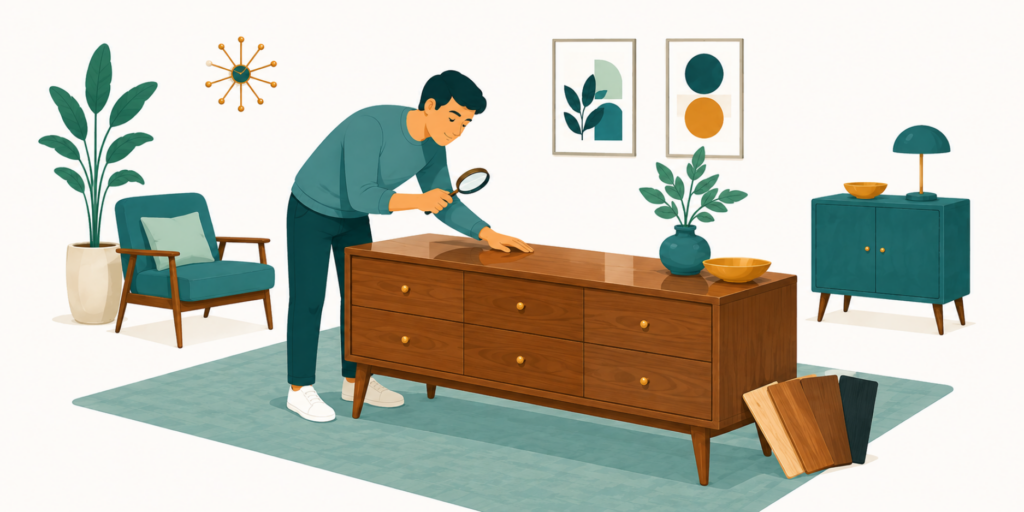
Feel the surface with your hand. It should be smooth and even from edge to edge with no rough spots or ripples. Check how the finish reflects light. A quality finish reflects consistently without waves or dull areas. Then, inspect hidden areas such as drawer interiors and the backs of cabinets. Quality manufacturers finish these areas as well, which prevents moisture damage and shows attention to detail. Raw wood on the inside is a clear sign of cost-cutting.
Principle 4: Comprehensive Warranties
A warranty reveals how much confidence a manufacturer has in their product. Strong warranties signal that the maker expects the furniture to last, and they are willing to stand behind the materials and construction. High-quality furniture typically includes ten to fifteen years of coverage on frames and structural components.
What Defines a Comprehensive Warranty
A reliable warranty should clearly outline what is covered, how long the coverage lasts, and what remedies are provided if something fails. It should cover defects in materials and workmanship without extensive exclusions. It should also include support for frames, joinery, springs, hardware, and major structural components. The document should be easy to read and available in writing.
Quality furniture warranties include:
- Structural and frame coverage of ten years or more
- Spring system coverage of at least five years
- Cushion coverage for foam breakdown for three to five years
- Finish coverage for defects for one to two years
Red Flags for Furniture Warranties
Short warranties that last only one or two years are a warning sign. Excessive exclusions are another. Be cautious of warranties that do not cover normal use, require the use of specific cleaners, or restrict coverage in ways that make the warranty useless. If a salesperson cannot explain the warranty clearly or provide a written copy, that is a sign to walk away.
Find High-Quality Furniture at Hudson’s Furniture + Mattress
You now have the knowledge to evaluate furniture like a professional. You understand the four principles that separate quality construction from cheap shortcuts: premium materials, superior craftsmanship, protective finishes, and comprehensive warranties.
At Hudson’s Furniture, we carefully select manufacturers who use solid hardwoods, proper joinery, and premium materials. Our team can show you exactly what to look for and explain why certain construction methods provide better durability. Visit one of our Florida showrooms to see quality furniture firsthand or browse our entire online furniture selection from the comfort of your home.
FAQs
How long should quality furniture last?
Solid wood furniture with proper construction can last 15 to 25+ years. Quality upholstered furniture lasts 10 to 20 years. Particle board furniture typically fails within 3 to 5 years. The difference comes down to materials and construction methods.
Is expensive furniture always better quality?
Not always. High prices sometimes reflect brand names, exclusive designs, or imported materials rather than superior construction. That’s why knowing how to evaluate quality yourself matters. You want to pay for solid materials and construction, not just a label.
What’s the difference between solid wood and veneer?
Solid wood is lumber cut directly from trees, with the grain continuing through the entire thickness. Veneer is a thin layer of real wood applied to a substrate. Quality veneer over plywood can be good, but veneer over particle board is a red flag. Check edges to see what’s underneath.
How can I tell if leather is real or fake?
Real leather has a distinctive smell, feels warm to the touch, and shows natural grain variations. When you sit on it, it warms quickly to your body temperature. Bonded leather feels cold and plasticky, has a chemical smell, and looks too perfect with uniform texture.
Are dovetail joints really that important?
Yes. Dovetail joints create a mechanical lock that holds firm through the shape itself, not just glue. They resist the pulling force of opening drawers repeatedly over years. Cheap furniture uses staples or simple butt joints that pull apart quickly.