
by Eric Hod | Design Manager, Hudson’s Furniture
Why Kitchen Hutches Are Making a Comeback
Most kitchens have a cabinet full of dishes that never see daylight. The good china stays boxed for holidays, the crystal stemware sits behind a cupboard door, and the linens your grandmother gave you live folded in a drawer somewhere. A kitchen hutch changes that. It gives those pieces a place to be seen, with open or glass-front shelving up top and closed storage below to keep everyday items out of view.
Hutches and buffets went out of style for a while, written off as formal furniture nobody had room for anymore. That’s changed. Designers are working them into modern dining rooms now, pairing a glass-front hutch with a sleek minimalist table or a traditional buffet with clean-lined chairs, and the mix works. A hutch, buffet, or china cabinet does more than store your dishware. It turns your best pieces into part of the room’s design.
At a Glance
A kitchen hutch is a freestanding cabinet with open or glass-front shelving on top and closed storage on the bottom, used for displaying dishware and storing kitchen or dining essentials. It differs from a buffet, which includes only the lower cabinet without the upper display case. Choosing the right hutch depends on your available wall space, storage needs, and the style of your dining room. Standard hutches range from about 36″ to 72″ wide and 72″ to 84″ tall, so measuring your space before shopping helps narrow the options.
What’s the Difference Between a Hutch, a Buffet, & a China Cabinet?
These three pieces get used interchangeably, but they’re built differently and serve different roles in a dining room. Knowing what separates them makes it easier to figure out which one actually fits what you’re trying to store and show off.
What Is a Kitchen Hutch?
A kitchen hutch is a two-part cabinet with a lower base for storage and an upper section with open or glass-front shelving for display. The upper section is where your good dishes, serving pieces, and glassware get seen instead of stored away. Many hutches come as a matched set with the base sold separately, so you can buy just the display portion if your space calls for it.
What Is a Buffet?
A buffet is the lower half of a hutch on its own, a wide cabinet with doors and drawers built for storage rather than display. It works well under a hutch top, but it also stands alone as a sideboard for serving during dinner parties or holding table linens, extra flatware, and serving trays. If display space isn’t a priority and you just need more storage in the dining room, a buffet does the job without the added height.
What Is a China Cabinet?
A china cabinet leans further into display than a hutch does, usually with more glass and less closed storage. Some stand as a single tall cabinet with glass on all sides, while others include a small drawer base below the display case. China cabinets work well for collectors and anyone whose main goal is showing off a full set of dishware rather than storing everyday items.
A curio cabinet follows the same idea on a smaller scale, built almost entirely of glass shelving for displaying collectibles, glassware, or small heirlooms rather than dishes meant for daily use.
Once you know which of these matches what you actually need, you can start narrowing down size and style. If display is the priority, browse Hudson’s china and display cabinets. If you want the full storage-and-display combination, browse hutches and buffets.
How Do You Choose the Right Size Hutch for Your Dining Room?
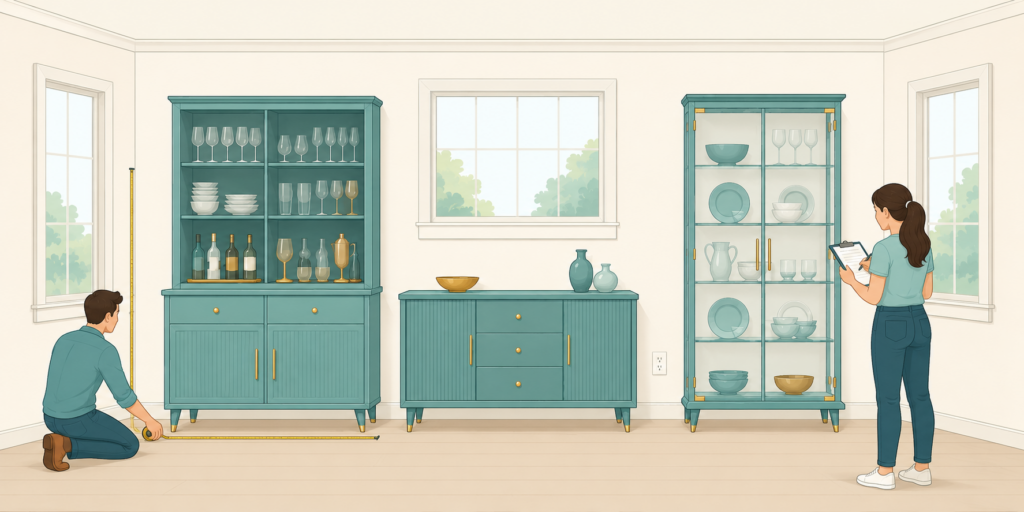
Getting the size right turns a hutch into a piece that looks like it was built for your dining room, not just placed in it. Measuring your space before you shop is the easiest way to land on a hutch that feels proportional to the room instead of overwhelming it or getting lost in it.
Step #1 – Measure Your Wall Space First
Grab a tape measure and measure the full width of the wall where you want the hutch to sit, from corner to corner. Walk the wall first and note anything you need ongoing access to, like a light switch, thermostat, or vent, since the hutch will need to sit clear of those spots rather than in front of them. Add at least 3″ of breathing room on each side so the piece doesn’t look wedged into the space. The number left over is your maximum hutch width.
If your dining room doubles as a walkway, measure the distance from the wall to the nearest chair when it’s pushed back from the table. You’ll want enough space left over, ideally 36″ or more, for someone to walk behind a seated guest without squeezing past the hutch.
Step #2 – Check Your Ceiling Height
Measure from the floor to the ceiling at the spot where the hutch will sit. Most hutches stand 72″ to 84″ tall, and matching that height to your ceiling keeps the proportions balanced instead of making the room feel cramped or the piece feel undersized.
In rooms with 8′ (96″) ceilings, stay closer to the 72″ to 78″ range so the hutch doesn’t crowd the ceiling. In rooms with 9′ or 10′ ceilings, a taller hutch in the 78″ to 84″ range fills the extra vertical space instead of leaving it empty above the piece.
Step #3 – Match the Hutch to Your Table & Chairs
Measure the length of your dining table, then aim for a hutch within 12″ to 18″ of that number in either direction. A hutch noticeably wider than the table can make the table look small by comparison, while a hutch that’s much narrower than the table can look like an afterthought next to it. This range flexes depending on the room’s overall scale, but it’s a reliable starting point for a proportional look.
Step #4 – Leave Room for the Doors & Drawers to Open Fully
A hutch that fits the wall on paper can still cause problems if its doors or drawers cannot open completely. Measure 24″ to 30″ out from the front of the hutch for glass-front doors to swing open fully, and measure the depth of the drawers plus a few extra inches so they can slide out without hitting a wall or another piece of furniture. Check the manufacturer’s spec sheet for exact clearances before you buy, since these numbers vary by model.
How Do You Style a Kitchen Hutch or China Cabinet?
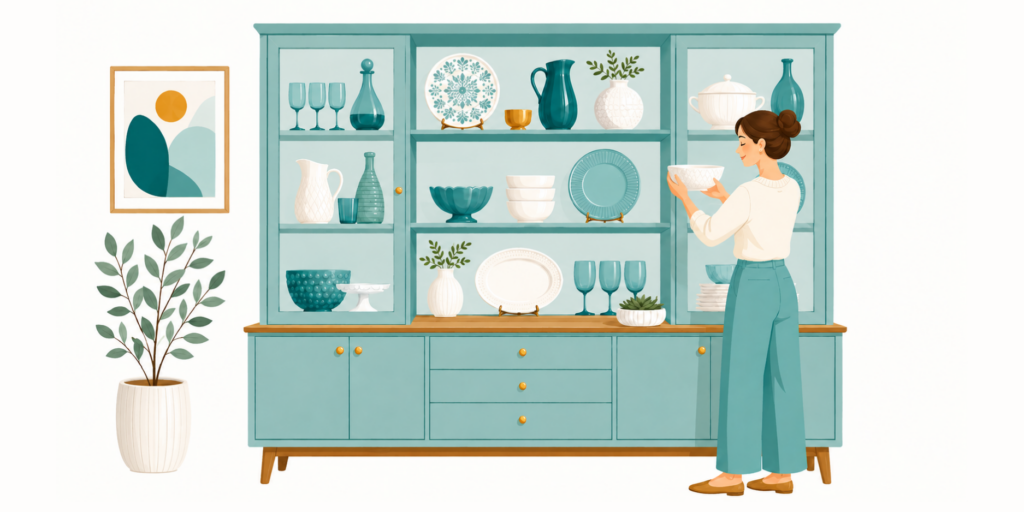
Once your hutch is in place, the shelves are where it earns its keep. A well-styled hutch looks curated rather than crowded, and a few simple habits make the difference.
- Group items in odd numbers: Displays read as more natural when items are grouped in threes or fives rather than pairs. A cluster of three matching plates or a trio of vases at different heights creates visual interest that a single item or a symmetrical pair doesn’t.
- Vary the height of what you display: Flat plates and short bowls can look monotonous lined up at the same height. Prop a few plates upright on stands, stack others, and let taller pieces like pitchers or vases break up the horizontal lines created by shelves.
- Leave breathing room on each shelf: A shelf packed edge-to-edge stops looking like a display and starts looking like storage. Leave visible space around each grouping so individual pieces stand out instead of blending into a wall of dishware.
- Layer in color & texture: An all-white shelf can look flat under glass. Mixing in a patterned platter, a piece of colored glass, or a textured serving bowl gives the eye somewhere to land and keeps the display from feeling like a single matching set.
- Rotate what you display seasonally: Swapping out a few pieces for the season, like trading everyday stoneware for holiday china in December, keeps the hutch feeling current instead of static. It also gives you a reason to actually use the pieces you’re storing rather than letting them sit behind glass indefinitely.
Find Your Perfect Hutch or China Cabinet at Hudson’s Furniture
The right hutch does more than hold your dishes. It turns pieces you already love into something you actually see every day, and it gives your dining room a focal point that reflects your style instead of just filling wall space.
Browse Hudson’s collection of hutches and buffets or china and display cabinets online to compare sizes and styles at your own pace, or visit a Hudson’s Furniture + Mattress showroom and let one of our design specialists help you find a piece that fits your space and your collection.
FAQs
What is the difference between a hutch and a buffet?
A hutch includes both a lower storage cabinet and an upper section with open or glass-front shelving for display. A buffet is just the lower cabinet on its own, built for storage rather than display. Some hutches come as a matched two-piece set with the buffet base sold separately.
What is a kitchen hutch used for?
Neither type wins outright. Hybrids sleep cooler, respond faster, and offer stronger edge support, while memory foam contours more closely and isolates motion better. Choose based on whether you value airflow and easy movement or deep pressure relief.
Are hybrid mattresses good for side sleepers?
A kitchen hutch stores everyday dining items in its lower cabinet while displaying dishware, glassware, and serving pieces on its upper shelves. It works as both functional storage and a decorative focal point in a dining room.
Do I need a hutch if I already have a buffet?
Not necessarily. A buffet alone works well if storage is your main need and you don’t have collectible dishware or china you want on display. A hutch makes more sense if you want a designated space to show off your best pieces.
What size hutch fits a standard dining room?
Most hybrids sleep cooler than all-foam beds because air moves freely through the coil core. Models with thick memory foam comfort layers can still retain some warmth. If you run hot, look for latex comfort layers, gel-infused foams, or cooling covers.
How far should a hutch be from the dining table?
There’s no fixed distance, but the hutch should sit far enough from the table that chairs can push back fully without hitting it. If the dining room doubles as a walkway, leave at least 36″ behind a seated chair for people to pass through comfortably.
Can a hutch go on a wall with a light switch or thermostat?
A hutch shouldn’t sit directly in front of a light switch, thermostat, or vent you need ongoing access to. Measure the wall first and plan the hutch’s placement around those fixtures rather than over them.
What’s the difference between a china cabinet and a curio cabinet?
A china cabinet typically includes more glass than a hutch and less closed storage, built mainly to display a full set of dishware. A curio cabinet is usually smaller and built almost entirely of glass shelving, designed for collectibles or small heirlooms rather than everyday dishes.
What firmness is best in a hybrid mattress?
Medium firm, 5 to 7 on the 10-point scale, works for the widest range of sleepers. Side sleepers often prefer 4 to 6, while stomach sleepers and heavier bodies do better at 7 to 8. Start with your sleep position, then adjust for body weight.
How do you style a hutch so it doesn’t look cluttered?
Group items in odd numbers, vary the height of what’s displayed, and leave visible space around each grouping instead of filling every inch of the shelf. Rotating a few pieces seasonally also keeps the display from feeling static.
Are hutches and buffets still in style?
Yes. Designers are working them into modern dining rooms, pairing glass-front hutches with minimalist tables and traditional buffets with clean-lined chairs. The style has moved past its formal, dated reputation.
Do all hutches come with glass doors?
No. Some hutches have fully open shelving, others have glass-front doors, and some combine both, with open display space on top and closed storage below. The right option depends on how much dust protection or visibility you want for your dishware.