
by Eric Hod | Design Manager, Hudson’s Furniture
How to Match the Right Storage Piece to Your Bedroom
A chest of drawers and a dresser get talked about like the same piece of furniture, and in casual conversation, the mix-up rarely matters. Both hold folded clothing. Both use stacked drawers. But once you’re shopping for one, the differences start to matter, because these two pieces suit different rooms and different storage habits.
A chest of drawers is tall and narrow, built to stack storage vertically in a small footprint. A dresser is low and wide, built to spread storage across more floor space and pairs naturally with a mirror on top. Neither piece beats the other outright; each one solves a different storage need depending on your room size, closet setup, and how you like to organize clothing.
Here’s how the two compare in height, drawer count, footprint, and price, along with which one fits a small bedroom, a primary suite, or a walk-in closet needing more storage.
At a Glance
A chest of drawers stands 40″ to 60″ tall on a narrow footprint, usually with 5 to 7 drawers in a single column. A dresser stands 30″ to 34″ tall and spans 60″ or wider, with 6 to 9 drawers and often a mirror on top. Chests suit small bedrooms and walk-in closets; dressers suit primary bedrooms with a full wall for a mirror.
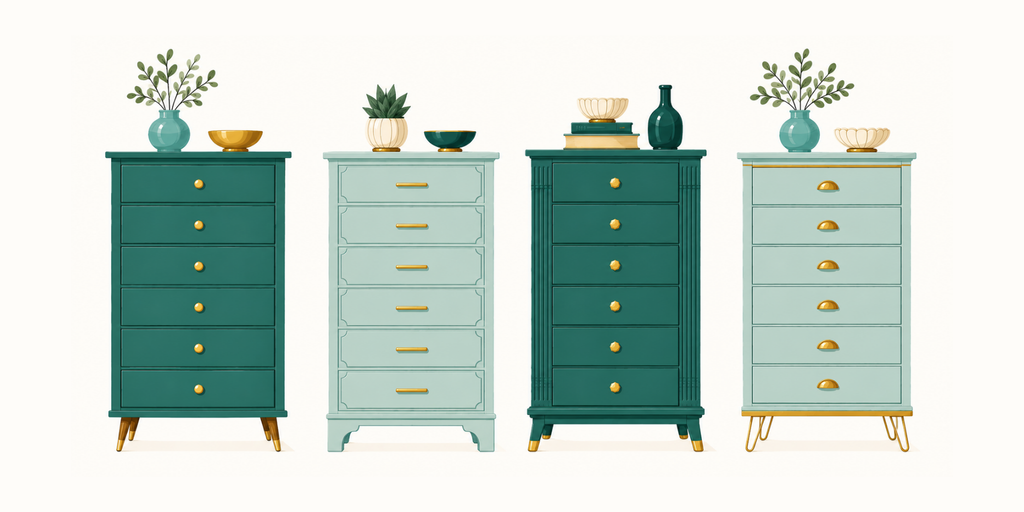
What Is a Chest of Drawers?
A chest of drawers is a tall, narrow storage piece built around 5 to 7 drawers, usually arranged in a single vertical column. Some chests break from that layout and split the upper section into two narrower drawers side by side above waist height, but a single column remains the standard build. The design favors height over width, so a chest occupies less floor space than most bedroom storage pieces while still holding a full wardrobe’s worth of folded clothing.
Taller versions, often called tallboys or highboys, climb past 60″ and add one or two extra drawers near the top. Because a chest of drawers takes up so little floor space, it works well in corners, walk-in closets, and narrow bedrooms where a wide piece wouldn’t fit. Drawers on a chest tend to run narrower and deeper than dresser drawers, suiting folded shirts, undergarments, and accessories better than bulky sweaters.
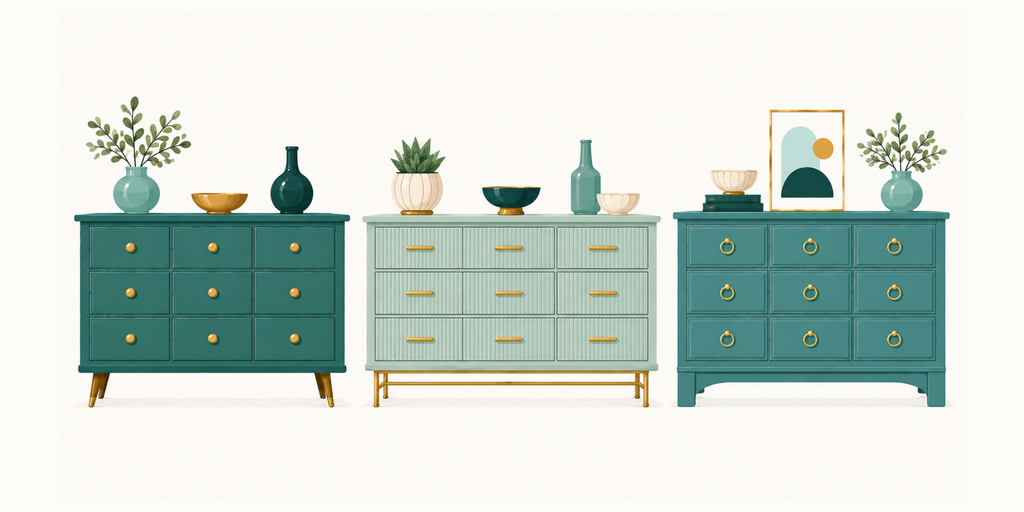
What Is a Dresser?
A dresser is a low, wide storage piece built around 6 to 9 drawers spread across two or three columns. The extra width lets a dresser sit lower to the ground, usually 30″ to 34″ tall, while still matching or beating a chest’s total storage capacity. This low profile also creates a flat, stable surface on top, which is why most dressers pair with a mirror.
Wider drawers give a dresser an edge with sweaters, jeans, and other bulky items hard to fold into a narrow drawer. A dresser also gives you a surface for a lamp, jewelry tray, or framed photos, something a chest’s height makes harder to use daily.
5 Key Differences Between a Chest of Drawers & a Dresser
Once you know what each piece is built for, the differences below explain exactly where they diverge and why it matters for your bedroom.
#1 – Height & Footprint
A chest of drawers stands 40″ to 60″ tall on a footprint around 30″ to 36″ wide and 18″ to 20″ deep. A dresser stands 30″ to 34″ tall but spans 60″ to 72″ wide on a similar 18″ to 20″ depth. The chest trades width for height; the dresser trades height for width.
#2 – Drawer Count & Layout
A chest of drawers typically holds 5 to 7 drawers, usually stacked in a single column with each drawer running the full width of the piece. A few chest styles split the top one or two drawers into a side-by-side pair above waist height, though this is the exception rather than the rule. A dresser typically holds 6 to 9 drawers split across two or three columns, giving you more drawers overall but each one narrower side to side.
#3 – Room Fit
A chest of drawers fits corners, walk-in closets, and narrow bedrooms where a wide dresser wouldn’t leave enough walking space. A dresser needs a full wall, usually 6′ or more, and works best in primary bedrooms or larger secondary bedrooms with room to spare. Measuring your available wall space before shopping prevents the most common furniture-fit mistake: buying a dresser too wide for the room.
#4 – Mirror Compatibility
A dresser’s low, wide top creates a stable base for a matching mirror, which is why most dresser and mirror sets sell as a pair. A chest of drawers stands too tall and narrow to safely support a mirror on top, so chest owners typically add a wall-mounted mirror instead. If a mirror above your storage piece matters to you, a dresser is the more practical choice.
#5 – Price Range
A chest of drawers generally costs $400 to $900, since it uses less material and a smaller frame. A dresser generally costs $600 to $1,500 depending on width and wood type, and a matching mirror typically adds $150 to $400 on top. Buying a dresser and mirror as a set usually costs less than purchasing each piece separately.
| Feature | Chest of Drawers | Dresser |
|---|---|---|
| Height | 40″ to 60″ | 30″ to 34″ |
| Width | 30″ to 36″ | 60″ to 72″ |
| Depth | 18″ to 20″ | 18″ to 20″ |
| Drawer Count | 5 to 7, stacked in one column | 6 to 9, split across two or three columns |
| Best For | Small bedrooms, closets, corners | Primary bedrooms with a full wall |
| Mirror Compatible | No, too tall and narrow | Yes, low and stable top |
| Price Range | $400 to $900 | $600 to $1,500 |
How to Choose Between a Chest of Drawers & Dresser
Your bedroom’s size and your storage habits point toward one piece more clearly than the other. Here’s how to match each option to your space.
Choose a Chest of Drawers If You…
A chest of drawers makes sense for smaller bedrooms, closets, and rooms where every square foot of floor space counts. It’s also a strong fit for kids’ rooms, guest rooms, and any spot with a narrow wall or an awkward corner.
- Have a small bedroom or limited wall space
- Need extra storage inside a walk-in closet
- Are furnishing a kid’s room, guest room, or small apartment
- Want a piece that fits a narrow wall or corner
- Prefer more vertical storage over a wide surface
Choose a Dresser If You…
A dresser makes sense for primary bedrooms with a full wall available, especially if you want a mirror at eye level or a surface for everyday items. It also suits anyone storing bulkier folded clothing like sweaters and jeans.
- Have a primary bedroom with 6′ or more of open wall
- Want a mirror positioned above your storage
- Fold sweaters, jeans, or other bulky items regularly
- Need a stable surface for a lamp, jewelry, or décor
- Are furnishing a shared bedroom with more clothing volume
Can You Use a Chest of Drawers & a Dresser Together?
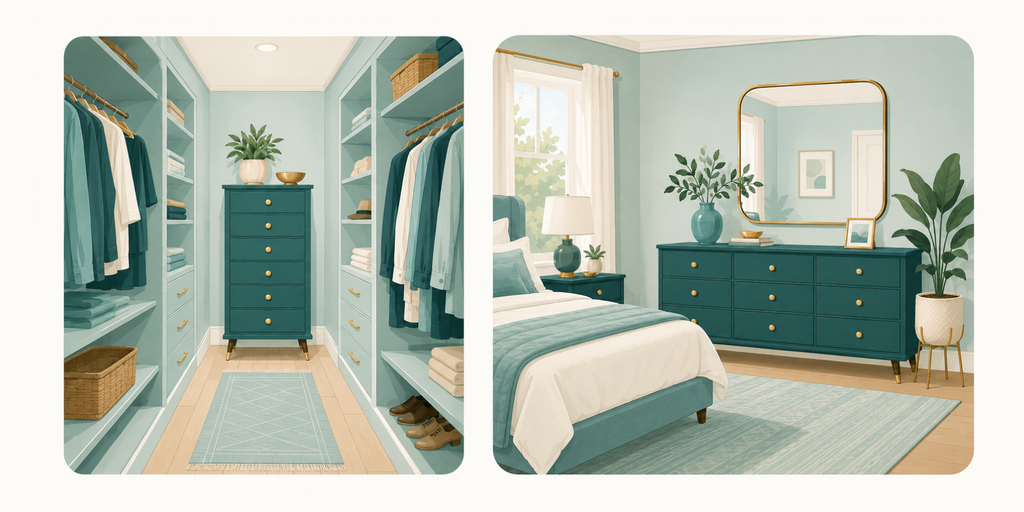
Yes, and it’s one of the most practical bedroom storage setups available. A dresser with a mirror typically anchors one wall, while a chest of drawers fills a corner, closet, or the wall beside a window where a second dresser wouldn’t fit. Pairing the two gives you more total storage than either piece alone, without giving up the mirror or crowding the room.
This combination works especially well in primary bedrooms shared by two people, where one partner uses the dresser and the other uses a chest of drawers tucked into the walk-in closet. It also solves storage shortages in smaller bedrooms, since the chest adds capacity without eating into walking space the way a second dresser would.
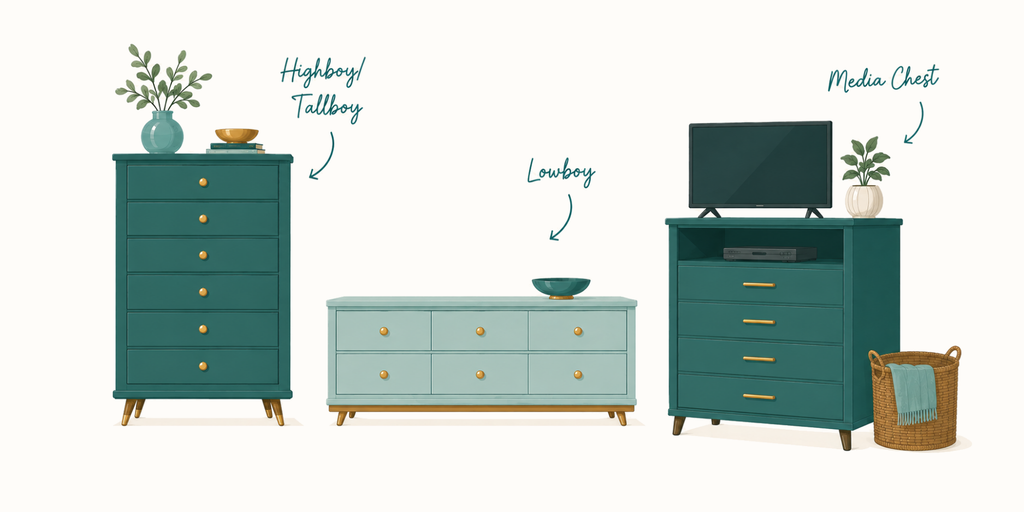
What Other Bedroom Storage Terms Should You Know?
A few related terms come up alongside chest of drawers and dresser, and knowing them helps you shop with more confidence.
- Highboy or Tallboy: A tall chest of drawers, often 60″ or taller, sometimes built with a slightly narrower top section set on a wider base.
- Lowboy: A short, wide chest, closer in height to a dresser but narrower in width, often used as a nightstand alternative or accent piece.
- Bureau: An older term for a dresser, still used interchangeably in some regions and by some furniture brands.
- Media Chest: A chest of drawers built with a reinforced top and cord access, made for a TV or media components instead of a mirror.
Find Your Perfect Bedroom Storage at Hudson’s Furniture + Mattress
A bedroom rarely runs short on things to store, and the right combination of a chest of drawers and a dresser, or the right single piece for a smaller room, makes daily organizing far easier. Once you know your wall space and your storage habits, the choice comes down to matching the piece to the room rather than guessing.
Browse Hudson’s collection of chests of drawers and dressers online to compare sizes and finishes at your own pace, or visit a Hudson’s Furniture + Mattress showroom, where our design specialists can help you measure your space and match a piece to your bedroom in person.
FAQs
What is the difference between a chest of drawers and a dresser?
A chest of drawers is tall and narrow, usually 40″ to 60″ tall, with 5 to 7 drawers stacked vertically. A dresser is low and wide, usually 30″ to 34″ tall, with 6 to 9 drawers spread across a wider footprint. The chest saves floor space, while the dresser adds a stable surface for a mirror.
Is a highboy the same as a chest of drawers?
A highboy is a taller version of a chest of drawers, typically standing 60″ or higher. Some highboys add a narrower top section set on a wider base, though the basic vertical drawer stack works the same way as a standard chest.
Which is better, a dresser or a chest of drawers?
Neither piece outperforms the other; the better option depends on your room and storage habits. A chest of drawers suits small bedrooms and walk-in closets, while a dresser suits primary bedrooms with a full wall and room for a mirror.
Can a chest of drawers hold a TV?
Standard chests aren’t built for TV weight or cord access, though media chests are a specific variation with a reinforced top made to hold one. Check the weight rating before placing a TV on any chest of drawers not labeled as a media chest.
Do chests of drawers come with mirrors?
No. A chest’s height and narrow top make it unstable for a mounted mirror, so chests almost never sell with one. A wall-mounted mirror is the more common pairing for a chest of drawers.
How many drawers does a dresser typically have?
Most dressers hold 6 to 9 drawers split across two or three columns. Larger triple dressers can hold more, while smaller double dressers sit at the lower end of the range.
What size bedroom fits a dresser?
A dresser needs a wall of at least 6′ to sit comfortably with walking clearance on both sides. Primary bedrooms and larger secondary bedrooms typically have enough wall space, while smaller rooms often fit a chest of drawers more easily.
Is a tallboy the same as a chest of drawers?
Yes. Tallboy and highboy both refer to a taller chest of drawers, generally 60″ or more in height, with the same vertical drawer layout as a standard chest.
Can a chest of drawers go inside a walk-in closet?
Yes, and it’s one of the most common uses for a chest of drawers. The narrow footprint fits inside most walk-in closets, adding drawer storage alongside hanging space without requiring a separate wall in the bedroom. A standard reach-in closet is usually too shallow to fit one and still swing the door.
What’s the difference between a chest of drawers and a bureau?
A bureau is an older term for a dresser, not a chest of drawers. Some regions and furniture brands still use bureau and dresser interchangeably, though the piece itself matches a dresser’s low, wide build.
Do dressers or chests of drawers cost more?
Dressers generally cost more, ranging from $600 to $1,500 depending on width and wood type, compared to $400 to $900 for most chests of drawers. The extra material and wider frame account for most of the price difference.
Which is better for storing sweaters and bulky clothing?
A dresser works better for sweaters, jeans, and other bulky folded items, since its drawers run wider side to side. A chest’s narrower, deeper drawers suit shirts, undergarments, and accessories more than bulky knitwear.